Additional pictures: back view
Here's one from the archives: a dress I've had for a while, but haven't written up here yet. This is a blue linen gown/kirtle that's a very basic part of my 15th century wardrobe. I have several similar ones, but this one in particular is cut with a very wide and very low neckline for wearing with my Burgundian court gown (about which I will hopefully write soon); however I also wear it with an earlier houppelande, and by itself with pin-on sleeves.
Construction Details: Unlined linen gown, handsewn with linen thread. Four-panel construction with waist seam; skirt portion has gores at front, back, and sides. Eyelets are on a separate strip to ease working with panels which are curved at the center front opening. This eyelet strip is four layers of fabric thick, to prevent buckling and gathering (2 layers of the outer fabric, and 2 layers of a more densely woven medium-weight linen). The eyelets are densely worked, approximately 5/8 inch apart on each side, approximately 3/8 inch back from the edge, and staggered between sides for spiral lacing.
Known Problems: The two main problems with this gown are both the choice of fabric. Firstly, I cannot document either colored linen, or linen used as an outer garment for this time and place. My best justification is how comfortable it is in the summer. The second problem is structural: the fabric is simply too coarsely woven to be really good for this style. I think I have had to mend this more times than anything else I own, because in seams under stress, the fabric will pull out of the stitching, one thread at a time. I think I've now fixed all the problem areas with reinforcement and multiple lines of stitching, but a tighter weave would have performed better.
Showing posts with label Flemish working class. Show all posts
Showing posts with label Flemish working class. Show all posts
10 May 2009


17 October 2006
15th c. Flemish working-class a la van der Weyden's Magdalena
This is the first outfit I made specifically for the SCA and with an eye to historical accuracy. Previously, I'd done a fair bit of sewing, but directed toward the theatrical, Renfest, and cosplay end of the spectrum.
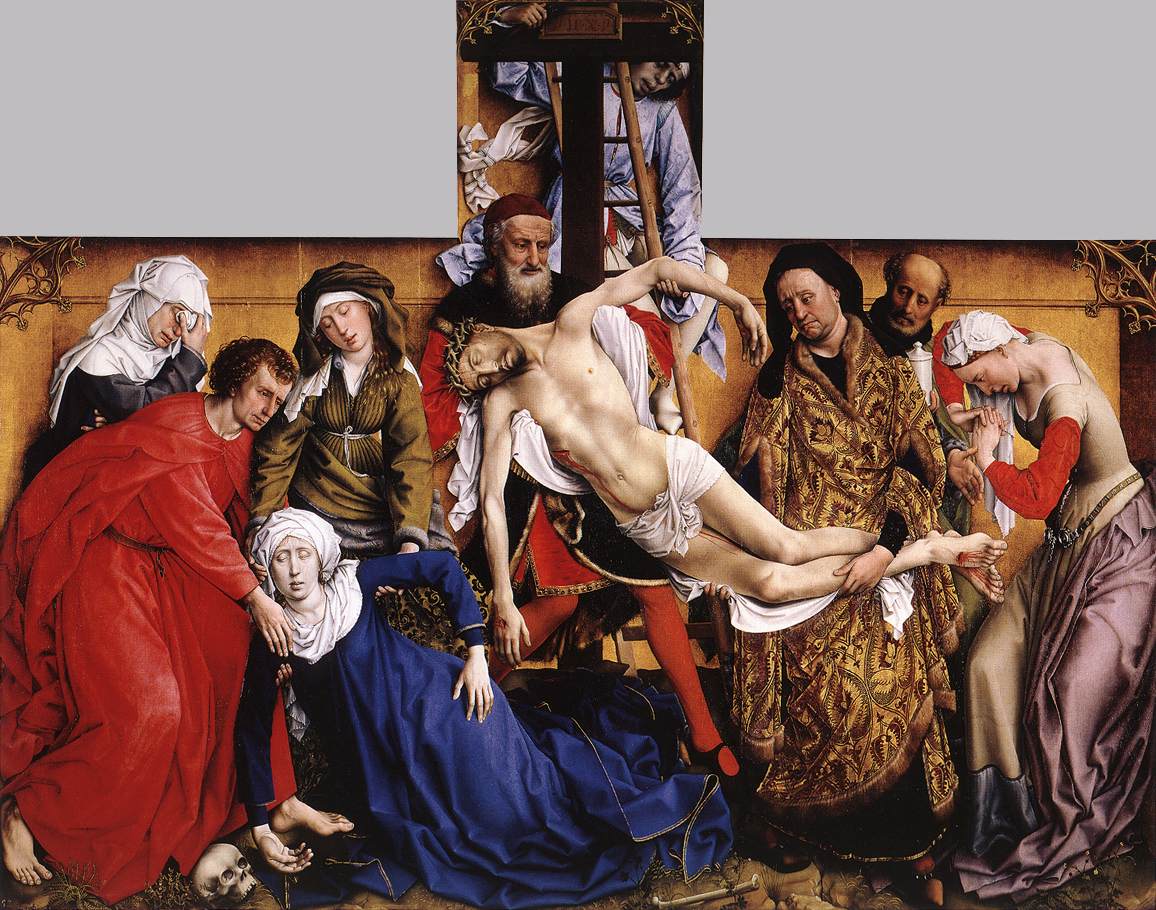
My direct inspiration for this gown was van der Weyden's 'Deposition', although I should note that this style is not restricted to depictions of Mary Magdalene. It seems to have been the basic working woman's dress of the 15th century; without oversleeves when working in the fields or the kitchen, with sleeves when in more public settings.
The gown itself is made of a lightweight worsted wool, unlined. I used a four-panel, three-gore (sides and back) construction, with raglan-cut short sleeves. I have material for a fourth gore that I have always intended to set into the front seam, but it seems increasingly unlikely that I ever will. The gown is not a self-supporting one - this is partly because it is unlined, and wool is moderately stretchy, but mostly because it was not sufficiently fitted for that. As a result, I now always wear this dress with a more tightly fitted linen underdress that provides support. Ideally, that would be the lining for the gown rather than a separate item, but it is functionally equivalent. The gown laces through 8mm sterling silver jump rings, soldered closed. They were bright and shiny when new, but quickly tarnished to a nice dark patina. This was all handsewn with silk thread.
The red pin-on sleeves are a poly-cotton damask and machine sewn. Each has two fabric-ball buttons at the wrist for a closer fit. The head wrap is a simple, very long rectangle of fine linen. The leather belt was made for me by my husband, using purchased brass reproduction hardware. I am also wearing a linen chemise (long sleeved, mid-calf length) and linen knee-high hose.

My direct inspiration for this gown was van der Weyden's 'Deposition', although I should note that this style is not restricted to depictions of Mary Magdalene. It seems to have been the basic working woman's dress of the 15th century; without oversleeves when working in the fields or the kitchen, with sleeves when in more public settings.
The gown itself is made of a lightweight worsted wool, unlined. I used a four-panel, three-gore (sides and back) construction, with raglan-cut short sleeves. I have material for a fourth gore that I have always intended to set into the front seam, but it seems increasingly unlikely that I ever will. The gown is not a self-supporting one - this is partly because it is unlined, and wool is moderately stretchy, but mostly because it was not sufficiently fitted for that. As a result, I now always wear this dress with a more tightly fitted linen underdress that provides support. Ideally, that would be the lining for the gown rather than a separate item, but it is functionally equivalent. The gown laces through 8mm sterling silver jump rings, soldered closed. They were bright and shiny when new, but quickly tarnished to a nice dark patina. This was all handsewn with silk thread.
The red pin-on sleeves are a poly-cotton damask and machine sewn. Each has two fabric-ball buttons at the wrist for a closer fit. The head wrap is a simple, very long rectangle of fine linen. The leather belt was made for me by my husband, using purchased brass reproduction hardware. I am also wearing a linen chemise (long sleeved, mid-calf length) and linen knee-high hose.
Subscribe to:
Posts (Atom)