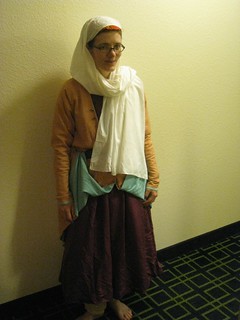
One of my long-term projects has been to slowly rehab and improve my Persian clothes. I made my first set many years ago, essentially on a whim, and entirely from fabric out of the stash. It's a lot of fun to wear something completely different than I normally do (and to hang out with my awesome Persian-persona friends), but it really wasn't up to my normal standards. So one of my goals has been to fix, replace, and add pieces for gradual improvement.
Here, I've swapped out my first coat layer for the new silk one I made this winter, although much of the interesting detail is hidden. (Please forgive the low-light hotel room photo) You can also glimpse just the tiniest bit of my braid case peeking out under the veil - a teaser for another post hopefully appearing soon. Next up? I need more bling! I definitely need to add jewelry, and I think my next coat should be a brocade.
Showing posts with label showcase. Show all posts
Showing posts with label showcase. Show all posts
04 April 2014


05 September 2013
The finally-finished surcoat
I was able to hem this in the car on the way to an event. (Although it ended up being too warm to need or want it.)
It really is a simple garment. Rectangular body; gores for front, back, and sides; and scoops cut for the neck and arms. Easier than a tunic.

It really is a simple garment. Rectangular body; gores for front, back, and sides; and scoops cut for the neck and arms. Easier than a tunic.
24 September 2012
The 'summer' Burgundian
It's been forever, but I made a new dress! I wanted something in the style of the reign for the (SCA) coronation of two good friends this summer. I wasn't able to wear it for very long that day though, because a chemise, a kirtle, plus a full gown even in a very lightweight wool is still too much for me if it is in the high 90s and humid. However, this picture comes from the second outing in mid-September when it was very comfortable all day.
I needed to cover the back of my neck, so I added a hood under my hat, which worked very well although it's not perfectly correct - the front edge should be straight rather than notched back. The liripipe is just wrapped around my bun under the hat.

I needed to cover the back of my neck, so I added a hood under my hat, which worked very well although it's not perfectly correct - the front edge should be straight rather than notched back. The liripipe is just wrapped around my bun under the hat.
05 April 2010
Housebook dress: Finished
I've covered the inspiration and construction in previous posts, so there's not a lot to say other than here's the finished product.
The chemises worn with this dress seem somewhat variable - some aren't visible, and those that are seem to have various cuts and styles, so I haven't made one particular for this gown (although a low-necked smocked one would be great). I've accessorized with a smocked linen apron. The pleats in the headwrap are sewn down for convenience, although linen does hold a nice edge with just ironing. I've got a fairly sizeable stuffed pad for the halo effect underneath; again, sizes in the artwork are variable from apparently none to quite large ones. It's set up like this: split hair, braid from just behind ears, loop around front and bobby pin above ears; clip stuffed roll (wulst) to now secured hair (mine has raw fabric edges around the inside which I can catch with small barrettes); drape pleated edge of veil over forehead, and secure front two corners to each other at back of head with one or two straight pins (I like longish brass ones for this); smooth out remainder of veil, twist remaining corners and tuck under; fin.

The chemises worn with this dress seem somewhat variable - some aren't visible, and those that are seem to have various cuts and styles, so I haven't made one particular for this gown (although a low-necked smocked one would be great). I've accessorized with a smocked linen apron. The pleats in the headwrap are sewn down for convenience, although linen does hold a nice edge with just ironing. I've got a fairly sizeable stuffed pad for the halo effect underneath; again, sizes in the artwork are variable from apparently none to quite large ones. It's set up like this: split hair, braid from just behind ears, loop around front and bobby pin above ears; clip stuffed roll (wulst) to now secured hair (mine has raw fabric edges around the inside which I can catch with small barrettes); drape pleated edge of veil over forehead, and secure front two corners to each other at back of head with one or two straight pins (I like longish brass ones for this); smooth out remainder of veil, twist remaining corners and tuck under; fin.
23 March 2010
Taymouth Hours gown
I first saw this particular illustration from the Taymouth Hours (ca. 1325-1350) a couple years ago, and I've wanted a dress in this style ever since. It's a woman, hunting a rabbit, and the dress she wears seems like it'd be very practical for shooting in the cooler parts of the year. It's short enough to not to get muddy, leaves the arms relatively free, and can be quite warm depending on materials. Mine is a somewhat light wool herringbone, fully lined with a moderately fulled wool flannel. (The originals probably would have been fur-lined, based both on artwork and written accounts, but that's above and beyond what I wanted to do in terms of work.) It's only slightly fitted, and pulls on over the head, so there's no laces or closures to be hidden. In the picture, I'm wearing it over my Moy gown recreation, which is a comfortable combination. (Please excuse the askew veil - that's the peril of forgetting to check a mirror!)
The cut of the outer fabric is quite sparing, just 2 yards of 60 inch fabric. The front and back main body panels were about 4 feet, and fit side by side, with the last 2 feet for side gores and sleeves. The lining actually required quite a bit more fabric, probably 3+ yards, for two reasons. First, after fulling the flannel it was no longer wide enough for two body panels, so those required separate lengths. Second, the turn back is fairly deep, so that had to be longer, plus it and the sleeves required a second interlining layer of the white flannel to be opaque over such a dark background.

The cut of the outer fabric is quite sparing, just 2 yards of 60 inch fabric. The front and back main body panels were about 4 feet, and fit side by side, with the last 2 feet for side gores and sleeves. The lining actually required quite a bit more fabric, probably 3+ yards, for two reasons. First, after fulling the flannel it was no longer wide enough for two body panels, so those required separate lengths. Second, the turn back is fairly deep, so that had to be longer, plus it and the sleeves required a second interlining layer of the white flannel to be opaque over such a dark background.
05 October 2009
1470s Burgundian gown
From the archives: the green Burgundian V-neck gown that I made in 2005-2006.
Few dresses are as iconic of medieval fashion as the V-neck gown that was popular in the court of the Dukes of Burgundy around 1475, thus called by reenactors the Burgundian gown. The fashion extended to nearby regions as well, of course, particularly the Low Countries which were held by Burgundy at that time, and similar styles were seen in France and England. This style of gown is an overgown, being worn over a chemise and a foundation gown; artwork of the period seems to indicate it was made of fairly thick material and fully lined, often with fur. As such, this is a very warm dress, and would replace a cloak or coat. There are some illustrations and paintings that seem to indicate velvet was also a possible lining option, based on color and painted texture, and I have at least one unusual example that shows a blue and gold brocade instead.
Construction details: Unlined gown of heavy-weight 100% wool melton, with silk velvet trim; hand-sewn with silk thread. The body construction uses four main panels, with selvage edges at front and back center seams. The V neckline is opened by pulling the selvage edge out to the side, not by cutting away material. In the back, the opening is filled in by a triangular piece. The side seams were shaped by draping to the body, and then gradually widen into the A-line skirt. The front opening extends slightly lower than the bottom of the belt; there are a few lacing rings on the inside edge to hold it closed. The sleeves are bias-cut to allow a closer fit, although they are slightly too long for me. I have chosen to only place the trim material at collar, cuff, and hem, where it shows, rather than fully lining the gown, due to the very limited quantities of silk velvet that I had. (It was taken from a vintage dress which had already been ruined by someone else's attempts at alterations.) The inset panel is a rectangle of red silk, pinned to the undergown layer. The gown neckline, as it has a tendency to pull out wider than I like, is also pinned down under the collar, to hold it in place.
Other details: I'm also wearing a beaded necklace, and a silk gauze veil over a truncated hennin, about which I might blog later. I will note that the veil is catching the flash in this photo, and is much more sheer under normal lighting conditions.

Few dresses are as iconic of medieval fashion as the V-neck gown that was popular in the court of the Dukes of Burgundy around 1475, thus called by reenactors the Burgundian gown. The fashion extended to nearby regions as well, of course, particularly the Low Countries which were held by Burgundy at that time, and similar styles were seen in France and England. This style of gown is an overgown, being worn over a chemise and a foundation gown; artwork of the period seems to indicate it was made of fairly thick material and fully lined, often with fur. As such, this is a very warm dress, and would replace a cloak or coat. There are some illustrations and paintings that seem to indicate velvet was also a possible lining option, based on color and painted texture, and I have at least one unusual example that shows a blue and gold brocade instead.
Construction details: Unlined gown of heavy-weight 100% wool melton, with silk velvet trim; hand-sewn with silk thread. The body construction uses four main panels, with selvage edges at front and back center seams. The V neckline is opened by pulling the selvage edge out to the side, not by cutting away material. In the back, the opening is filled in by a triangular piece. The side seams were shaped by draping to the body, and then gradually widen into the A-line skirt. The front opening extends slightly lower than the bottom of the belt; there are a few lacing rings on the inside edge to hold it closed. The sleeves are bias-cut to allow a closer fit, although they are slightly too long for me. I have chosen to only place the trim material at collar, cuff, and hem, where it shows, rather than fully lining the gown, due to the very limited quantities of silk velvet that I had. (It was taken from a vintage dress which had already been ruined by someone else's attempts at alterations.) The inset panel is a rectangle of red silk, pinned to the undergown layer. The gown neckline, as it has a tendency to pull out wider than I like, is also pinned down under the collar, to hold it in place.
Other details: I'm also wearing a beaded necklace, and a silk gauze veil over a truncated hennin, about which I might blog later. I will note that the veil is catching the flash in this photo, and is much more sheer under normal lighting conditions.
10 May 2009
Blue linen foundation gown
Additional pictures: back view
Here's one from the archives: a dress I've had for a while, but haven't written up here yet. This is a blue linen gown/kirtle that's a very basic part of my 15th century wardrobe. I have several similar ones, but this one in particular is cut with a very wide and very low neckline for wearing with my Burgundian court gown (about which I will hopefully write soon); however I also wear it with an earlier houppelande, and by itself with pin-on sleeves.
Construction Details: Unlined linen gown, handsewn with linen thread. Four-panel construction with waist seam; skirt portion has gores at front, back, and sides. Eyelets are on a separate strip to ease working with panels which are curved at the center front opening. This eyelet strip is four layers of fabric thick, to prevent buckling and gathering (2 layers of the outer fabric, and 2 layers of a more densely woven medium-weight linen). The eyelets are densely worked, approximately 5/8 inch apart on each side, approximately 3/8 inch back from the edge, and staggered between sides for spiral lacing.
Known Problems: The two main problems with this gown are both the choice of fabric. Firstly, I cannot document either colored linen, or linen used as an outer garment for this time and place. My best justification is how comfortable it is in the summer. The second problem is structural: the fabric is simply too coarsely woven to be really good for this style. I think I have had to mend this more times than anything else I own, because in seams under stress, the fabric will pull out of the stitching, one thread at a time. I think I've now fixed all the problem areas with reinforcement and multiple lines of stitching, but a tighter weave would have performed better.

Here's one from the archives: a dress I've had for a while, but haven't written up here yet. This is a blue linen gown/kirtle that's a very basic part of my 15th century wardrobe. I have several similar ones, but this one in particular is cut with a very wide and very low neckline for wearing with my Burgundian court gown (about which I will hopefully write soon); however I also wear it with an earlier houppelande, and by itself with pin-on sleeves.
Construction Details: Unlined linen gown, handsewn with linen thread. Four-panel construction with waist seam; skirt portion has gores at front, back, and sides. Eyelets are on a separate strip to ease working with panels which are curved at the center front opening. This eyelet strip is four layers of fabric thick, to prevent buckling and gathering (2 layers of the outer fabric, and 2 layers of a more densely woven medium-weight linen). The eyelets are densely worked, approximately 5/8 inch apart on each side, approximately 3/8 inch back from the edge, and staggered between sides for spiral lacing.
Known Problems: The two main problems with this gown are both the choice of fabric. Firstly, I cannot document either colored linen, or linen used as an outer garment for this time and place. My best justification is how comfortable it is in the summer. The second problem is structural: the fabric is simply too coarsely woven to be really good for this style. I think I have had to mend this more times than anything else I own, because in seams under stress, the fabric will pull out of the stitching, one thread at a time. I think I've now fixed all the problem areas with reinforcement and multiple lines of stitching, but a tighter weave would have performed better.
12 January 2009
Finished 'fleur-de-lys' gown with hat

I really had a great time at 12th Night in this outfit; the hat especially is just so much fun (and other people seemed to think so too, which always makes my day).
Final wrap-up on the project:
The dress I am mostly happy with, although it's been a long road with some serious doubts along the way. It doesn't look quite as nice as I originally imagined in my head, but it does still look good. The fabric, a rare find I just couldn't pass up, has a bit too much body to it to drape quite right. Coupled with my decision to go with a pullover style and skip a long opening, and you can't get the body-skimming fit and soft folds that the inspiration has. If I was doing this dress again, I'd either pick a fabric with a softer hand (let me know if you find any wool brocade, mmmkay?), or I'd put an invisible zipper in one of the side seams under the arm. Plausibly, the original might have been laced (front, back, or side, there's no way to know), but I just couldn't picture it, and the thought of putting stress-bearing eyelets into satin makes me want to run screaming.
The hat I'm more positive on; essentially my only reservation is that it's a little larger than I intended. I failed to account for the extra volume taken up by the covering of feathers, which was just a silly oversight. So it's even more over-the-top, and I can hardly be sad about that. My technique at sewing feathers has improved quite a bit too - it's harder to do on a solid base like this than a flat hat like the Tellebarrett where you can work from both the top and the bottom.
03 September 2007
16th c. Persian ensemble, with finished hat
This is my 16th c. Persian ensemble, with the previously blogged hat. I've got a deceptive amount of clothing on here: both visible coats are fully lined, plus the chemise-type layer and pants beneath. So it's not well suited to hot weather, yet somehow I always seem to wear it in the summertime anyway. I do like this outfit a lot; it feels very comfortable and relaxed.
My pirahan (chemise) is white lightweight linen, and the salwar (pants) are a soft, drapey linen in pale yellow. (At least, it was supposed to be linen; it feels suspiciously like a blend, though.) My inner coat is white cotton lined with a purple linen/cotton blend. The outer coat is definitely the nicest piece - peach silk twill, lined with a turquoise linen/cotton blend. All of these are based on the patterns at Roxane Farabi's website. The tiara secures a small, rectangular linen veil. I frequently also drape a my largest linen veil as a chador, but the heat and wind on this particular day made it beyond impractical.

My pirahan (chemise) is white lightweight linen, and the salwar (pants) are a soft, drapey linen in pale yellow. (At least, it was supposed to be linen; it feels suspiciously like a blend, though.) My inner coat is white cotton lined with a purple linen/cotton blend. The outer coat is definitely the nicest piece - peach silk twill, lined with a turquoise linen/cotton blend. All of these are based on the patterns at Roxane Farabi's website. The tiara secures a small, rectangular linen veil. I frequently also drape a my largest linen veil as a chador, but the heat and wind on this particular day made it beyond impractical.
05 March 2007
Finished Kampfrau gown
This is my finished early 16th c. German common woman's outfit. I'm very pleased with how everything turned out. Gown is heavy wool and trimmed in a lighter wool, with bodice lined and interlined in linen; sewn with silk and some linen thread and closes with hooks and eyes. Hemd (chemise) is lightweight linen, sewn with linen and smocked with black silk embroidery thread; closes with two pairs of hooks and eyes at the neck. Hat is wool bedecked in ostrich feathers, shape held by 8 gauge copper wire. The set-up under the hat is a fine example of last-minute materials-on-hand costuming - I'm using a couple of skeins of wool yarn to create the wulst bulge (fake braids would be preferable - easier to arrange and less squishy) and the veil over it is neither the right size or shape (but workable with enough pins and patience). The gown and hat used patterns from Reconstructing History; the chemise is my own design.

20 November 2006
Early 15th c. houppelande with veils
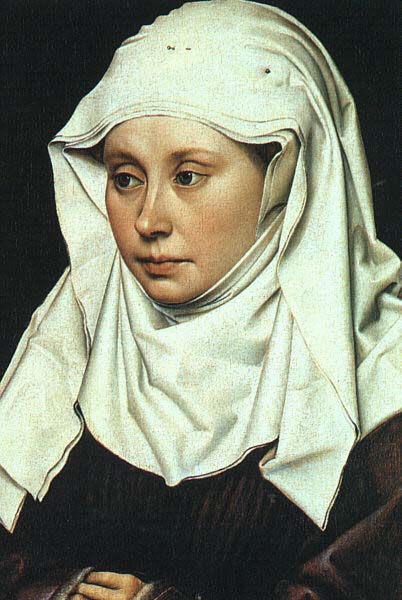
I made this houppelande a couple of years ago, but I think it has always suffered from a lack of appropriate headgear. So this week I made up three new linen veils to arrange in the style of this portrait by Campin. Dates for that painting seem to be around 1430.
The houppelande was originally a 'scraps project' - in other words, what can I make out of this fabric that was leftovers from somebody else. It is a poly-cotton damask originally in an off-white tone-on-tone pattern. Several bottles of RIT later, and it's pretty nice in color (if not in design) since the polyester and cotton threads take up dye quite differently. It's cut without any sort of pattern in a very basic A-line shape, and fully lined in a very short pile faux fur. I'm wearing a linen chemise and short-sleeved kirtle underneath. The chemise sleeves are a bit long, which is why one is peeking out.
The bumps in this fairly conservative veil style are still small enough that I can just use my own hair pulled into two braided buns rather than building something more structural. The first veil is a small rectangular one, doubled over; wide enough to cover the top of my head and long enough to reach my shoulders. It goes across my forehead, around the bumps, in front of my ears, and the back edges are then pinned behind my neck to keep it from sliding forward. The second veil is a circle, 2 foot diameter and folded in half, and arranged as a wimple. The third veil is a large square veil, again folded in half, on top of everything. (The original is actually folded in the other direction, so it would have be a long skinny rectangle, approximately 4:1.) I pinned pretty securely into my hair, and it really didn't move all day. It also kept me fairly warm, which was a good thing.

The houppelande was originally a 'scraps project' - in other words, what can I make out of this fabric that was leftovers from somebody else. It is a poly-cotton damask originally in an off-white tone-on-tone pattern. Several bottles of RIT later, and it's pretty nice in color (if not in design) since the polyester and cotton threads take up dye quite differently. It's cut without any sort of pattern in a very basic A-line shape, and fully lined in a very short pile faux fur. I'm wearing a linen chemise and short-sleeved kirtle underneath. The chemise sleeves are a bit long, which is why one is peeking out.
The bumps in this fairly conservative veil style are still small enough that I can just use my own hair pulled into two braided buns rather than building something more structural. The first veil is a small rectangular one, doubled over; wide enough to cover the top of my head and long enough to reach my shoulders. It goes across my forehead, around the bumps, in front of my ears, and the back edges are then pinned behind my neck to keep it from sliding forward. The second veil is a circle, 2 foot diameter and folded in half, and arranged as a wimple. The third veil is a large square veil, again folded in half, on top of everything. (The original is actually folded in the other direction, so it would have be a long skinny rectangle, approximately 4:1.) I pinned pretty securely into my hair, and it really didn't move all day. It also kept me fairly warm, which was a good thing.
24 October 2006
A schaube - my new replacement cloak
This wasn't one of my most heavily researched projects, but it was made from just materials on hand, and is fairly period. I mostly based it around woodcuts at Myra's schaube documentation. The Curious Frau's schaube dress diary also has good images (although the style shown is a bit later). The short length is unusual, but it's very convenient, and there is at least a little evidence for it.
It is made of a coat-weight wool, and fully lined in a bright red linen. The fur collar is a piece I inherited (it went with a matching stole) - mink, I think. You can't see it at all in the photo, but it closes at the neck with a cast pewter button (which happens to feature the device of my favorite Barony :-) ); I've got additional buttons that I plan to add eventually, but even one button does a good job of keeping the coat closed.
I definitely prefer a coat like this over a cloak; it kept me warm in chilly, windy weather this weekend, and I didn't have to take it off to shoot (a little tricky with the quiver, though). If I was going to make another one, I think the sleeves are too narrow, and I'm not totally happy with the A-line look of it. I think that's mostly a function of the stiffness of the wool, so I'm hoping it may soften up with more use.

It is made of a coat-weight wool, and fully lined in a bright red linen. The fur collar is a piece I inherited (it went with a matching stole) - mink, I think. You can't see it at all in the photo, but it closes at the neck with a cast pewter button (which happens to feature the device of my favorite Barony :-) ); I've got additional buttons that I plan to add eventually, but even one button does a good job of keeping the coat closed.
I definitely prefer a coat like this over a cloak; it kept me warm in chilly, windy weather this weekend, and I didn't have to take it off to shoot (a little tricky with the quiver, though). If I was going to make another one, I think the sleeves are too narrow, and I'm not totally happy with the A-line look of it. I think that's mostly a function of the stiffness of the wool, so I'm hoping it may soften up with more use.
17 October 2006
15th c. Flemish working-class a la van der Weyden's Magdalena
This is the first outfit I made specifically for the SCA and with an eye to historical accuracy. Previously, I'd done a fair bit of sewing, but directed toward the theatrical, Renfest, and cosplay end of the spectrum.
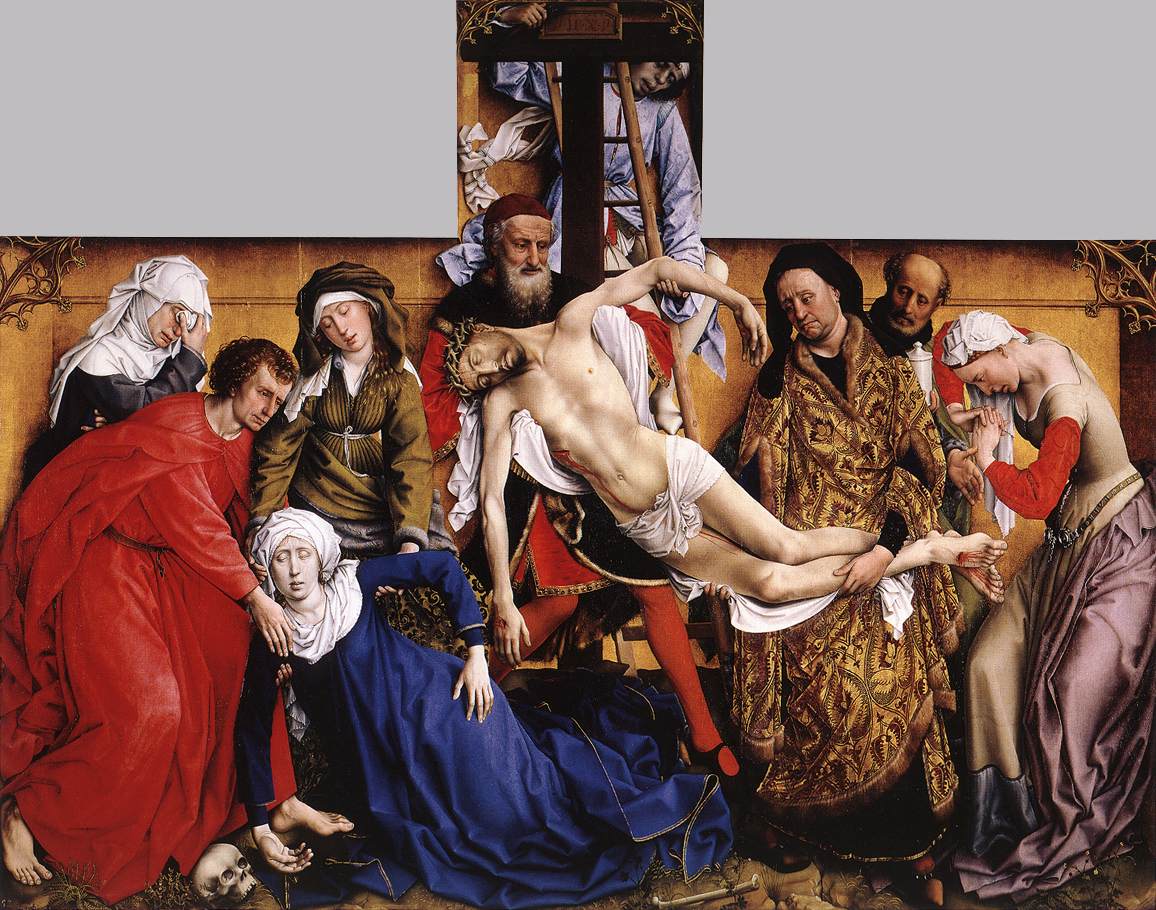
My direct inspiration for this gown was van der Weyden's 'Deposition', although I should note that this style is not restricted to depictions of Mary Magdalene. It seems to have been the basic working woman's dress of the 15th century; without oversleeves when working in the fields or the kitchen, with sleeves when in more public settings.
The gown itself is made of a lightweight worsted wool, unlined. I used a four-panel, three-gore (sides and back) construction, with raglan-cut short sleeves. I have material for a fourth gore that I have always intended to set into the front seam, but it seems increasingly unlikely that I ever will. The gown is not a self-supporting one - this is partly because it is unlined, and wool is moderately stretchy, but mostly because it was not sufficiently fitted for that. As a result, I now always wear this dress with a more tightly fitted linen underdress that provides support. Ideally, that would be the lining for the gown rather than a separate item, but it is functionally equivalent. The gown laces through 8mm sterling silver jump rings, soldered closed. They were bright and shiny when new, but quickly tarnished to a nice dark patina. This was all handsewn with silk thread.
The red pin-on sleeves are a poly-cotton damask and machine sewn. Each has two fabric-ball buttons at the wrist for a closer fit. The head wrap is a simple, very long rectangle of fine linen. The leather belt was made for me by my husband, using purchased brass reproduction hardware. I am also wearing a linen chemise (long sleeved, mid-calf length) and linen knee-high hose.


My direct inspiration for this gown was van der Weyden's 'Deposition', although I should note that this style is not restricted to depictions of Mary Magdalene. It seems to have been the basic working woman's dress of the 15th century; without oversleeves when working in the fields or the kitchen, with sleeves when in more public settings.
The gown itself is made of a lightweight worsted wool, unlined. I used a four-panel, three-gore (sides and back) construction, with raglan-cut short sleeves. I have material for a fourth gore that I have always intended to set into the front seam, but it seems increasingly unlikely that I ever will. The gown is not a self-supporting one - this is partly because it is unlined, and wool is moderately stretchy, but mostly because it was not sufficiently fitted for that. As a result, I now always wear this dress with a more tightly fitted linen underdress that provides support. Ideally, that would be the lining for the gown rather than a separate item, but it is functionally equivalent. The gown laces through 8mm sterling silver jump rings, soldered closed. They were bright and shiny when new, but quickly tarnished to a nice dark patina. This was all handsewn with silk thread.
The red pin-on sleeves are a poly-cotton damask and machine sewn. Each has two fabric-ball buttons at the wrist for a closer fit. The head wrap is a simple, very long rectangle of fine linen. The leather belt was made for me by my husband, using purchased brass reproduction hardware. I am also wearing a linen chemise (long sleeved, mid-calf length) and linen knee-high hose.
Subscribe to:
Posts (Atom)