This dress has been done for months, but I hadn't gotten any pictures of it until now. Like I outlined in my post on creating the pattern, it's a very simple cut with 4 identical panels, and each panel has a vertical dart for tailoring. The darts in the back are much shallower than the ones in the front, and might be skipped entirely for some women. The straps are long loops made from 1 inch strips of the same fabric as the dress, folded in itself twice.
I'm happy with the overall fit and look of the dress, but not entirely satisfied with it as a recreation based on the Hedeby fragment. While I was able to incorporate most of the features of the piece, the location of the hole near the upper edge of the piece didn't match up with anywhere I could plausibly position a strap, either on the front or the back.
Showing posts with label apron dress. Show all posts
Showing posts with label apron dress. Show all posts
03 March 2008


17 August 2007
Apron dress details: herringbone stitch
The write-up for the Hedeby find lists herringbone stitch as being used to finish the top edge, and I've done likewise, as shown here. It's a slightly unusual choice, as herringbone is more typically done as a decorative stitch or in simple embroidery. Thinking about it, though, it should be a fairly effective way of finishing a single-fold edge. Because of the stitch's zig-zag pattern, the weave is held together both along and across the grain. I'll see how effective it is in practice, although my fabric isn't likely to fray in the first place.
The write-up isn't particularly clear about whether the stitch faces in or out; I've chosen to have what is normally the face of the stitch on the inside of the garment, right on the raw edge. The backside of the stitch looks like two rows of running stitch, and is nearly invisible on the exterior of the dress (picture here).

The write-up isn't particularly clear about whether the stitch faces in or out; I've chosen to have what is normally the face of the stitch on the inside of the garment, right on the raw edge. The backside of the stitch looks like two rows of running stitch, and is nearly invisible on the exterior of the dress (picture here).
06 May 2007
An apron dress pattern based on the Hedeby fragment
Let me preface this by saying that Viking-era Norse is totally outside the areas I normally research. As much as I am not an expert on the topics I normally write about, I am even less of an expert on this.
There's a nearly dizzying array of different apron dress styles and reconstruction theories. For this project, I knew that I specifically wanted one of the closed styles, with at least a little bit of tailoring, so that leaves out the wrapped, tubular, and open-front styles which I won't talk about at all. The primary evidence for this style of garment seems to come from a fragmentary find from Hedeby harbor (aka Haithabu). The find is dated approximately to the 10th century, in an area now in Germany near Denmark. The find was described by Inga Hågg in German; I do not have a copy of the original article. For reference I am using a translation found halfway down this pdf. [Note: This is a more direct link to the pertinent material.] I am working under the assumption that it does represent a fragment of an apron dress, and not some other unknown garment.
The picture for this post shows my drawing of the fragment itself (1:1 based on the measurements given in the article); it's sitting on top of the pieces I'm using for my garment, and the background is a 1 inch grid for size reference. There's a picture showing the full length here. The jagged black line represents the surviving edge of what was found; I've extended it to get a feel for the possible original shape. The main features to note are that both long edges show stitch holes along their length, and the top edge is hemmed. There's a vertical dart which was covered by a six-strand braid. Two areas of the wool are felted, apparently from wear: a band about 6 inches below the top of the piece, and the area around a hole in one corner. There's another hole where the dart meets the felted band, and the dart's widest point is here (it narrows above and below).
It's worth noting that there are a number of reconstructions based on similarly-shaped pieces (one two three four). Of these, the second and third seem to have been especially popular with re-enactors; they are essentially made from 3 Hedeby-shaped pieces cut on a fold, with or without additional gores. The first uses shaped fragments for it's side panels with rectangular front and back panels. The fourth uses 4 similarly shaped panels, but with front and back pieces significantly wider than those at the sides.
One of the biggest problems with interpreting the Hedeby fragment is its size. I don't just mean it's size as a relative to the entire garment (although it's not huge), but it's actual measurements. The top edge is only about 6 inches long. If one assumes that the garment is made of identical panels, 6 are needed to fit an approximately average-sized woman. Although I'm not at all sure, I suspect that this is the origin of the patterns that use three-fold symmetry, something that has always nagged me a bit. As far as I can tell, while two- and four-fold symmetry seem very common in early clothing construction, three-fold is extremely rare - I can't think of any other example. That's not to say it's impossible, but just that it strikes me as a weird. If, on the other hand, one assumes variable size panels and that the Hedeby fragment represents one of the smaller side panels, positioning of the hole which is thought to be a strap attachment point becomes practically under the arm.
The other point about size with regards to the fragment is its vertical measurement. As I mentioned above, the band of wear which almost certainly represents a belt is a mere six inches below the top of the piece. I am aware that very little belt hardware has been found in connection with the graves of Norse women, but a belt may have been simply tied, or fastened with hardware made of a material that wasn't preserved (perhaps bone or antler?). The widest part of the dart is also at this point, which supports my belief that this line represents the natural waist of the wearer.
Now, I don't have a particularly long torso (somewhat short, if anything), but six inches above my natural waist is still below my bust line. An apron dress made to the measurements of the fragment would have to sit below my chest, with brooches forming a metal Brunhilda-bra. Aside thinking that this would be absurd, I'll note that brooches in grave finds seem to have been positioned higher than that. Even if we propose that this represents the back, and the front piece would come higher, it is still very low cut and would require long straps. Practical considerations seem to dictate that the upper edge of the apron dress should be higher, with shorter straps, to help it stay up.
All of this is a very long way to get to the point of my new, out-on-a-limb theory: that the Hedeby fragment may represent not the dress of an adult woman, but a young girl. This would account for the apparently small size both in width and height of the piece - 4 identical panels of this size would be an appropriate size for a child, I think (note that I don't have any children to test this out on). This interpretation also allows the decorated dart seams to be in the front rather than the back. The placement of the strap does still seem to be a bit too far out to the side, but I've decided to test my theory by scaling the pieces up to my size (about 60-70% larger) and testing where straps would need to be.
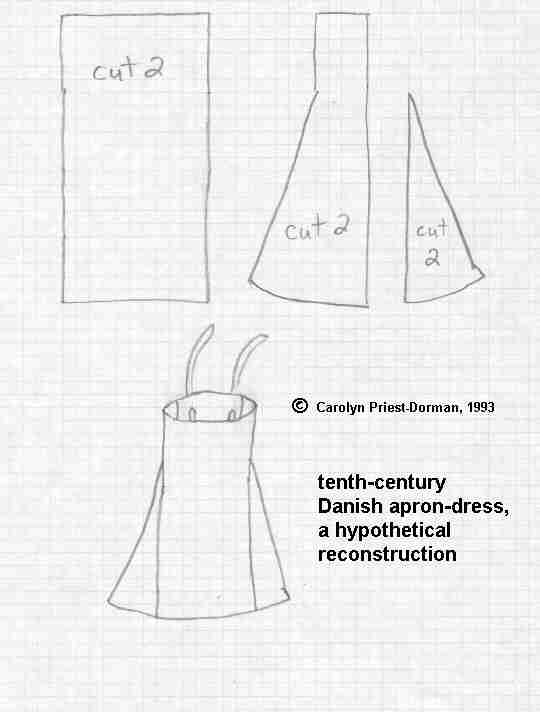
So, in a nutshell, my pattern is 4 panels shaped similarly to the Hedeby fragment, but significantly larger, with straight seams at center front and center back, and shaped side seams. In my mock-up, I found that the flare at the side seam gave sufficient room at the hips and hem, and no additional gore pieces were needed. This can be cut efficiently from narrow cloth if the length of the garment is taken to be the entire width of the fabric (the top edge of the find is a selvedge, and the grain runs horizontally, rather than vertically). My dress would have required a fabric width of 34 inches for its below-knee length; I don't have any information on available fabric widths for this time - a narrow 22 inch fabric would produce a mid-thigh length garment on me, or a longer dress on a child.

There's a nearly dizzying array of different apron dress styles and reconstruction theories. For this project, I knew that I specifically wanted one of the closed styles, with at least a little bit of tailoring, so that leaves out the wrapped, tubular, and open-front styles which I won't talk about at all. The primary evidence for this style of garment seems to come from a fragmentary find from Hedeby harbor (aka Haithabu). The find is dated approximately to the 10th century, in an area now in Germany near Denmark. The find was described by Inga Hågg in German; I do not have a copy of the original article. For reference I am using a translation found halfway down this pdf. [Note: This is a more direct link to the pertinent material.] I am working under the assumption that it does represent a fragment of an apron dress, and not some other unknown garment.
The picture for this post shows my drawing of the fragment itself (1:1 based on the measurements given in the article); it's sitting on top of the pieces I'm using for my garment, and the background is a 1 inch grid for size reference. There's a picture showing the full length here. The jagged black line represents the surviving edge of what was found; I've extended it to get a feel for the possible original shape. The main features to note are that both long edges show stitch holes along their length, and the top edge is hemmed. There's a vertical dart which was covered by a six-strand braid. Two areas of the wool are felted, apparently from wear: a band about 6 inches below the top of the piece, and the area around a hole in one corner. There's another hole where the dart meets the felted band, and the dart's widest point is here (it narrows above and below).
It's worth noting that there are a number of reconstructions based on similarly-shaped pieces (one two three four). Of these, the second and third seem to have been especially popular with re-enactors; they are essentially made from 3 Hedeby-shaped pieces cut on a fold, with or without additional gores. The first uses shaped fragments for it's side panels with rectangular front and back panels. The fourth uses 4 similarly shaped panels, but with front and back pieces significantly wider than those at the sides.
One of the biggest problems with interpreting the Hedeby fragment is its size. I don't just mean it's size as a relative to the entire garment (although it's not huge), but it's actual measurements. The top edge is only about 6 inches long. If one assumes that the garment is made of identical panels, 6 are needed to fit an approximately average-sized woman. Although I'm not at all sure, I suspect that this is the origin of the patterns that use three-fold symmetry, something that has always nagged me a bit. As far as I can tell, while two- and four-fold symmetry seem very common in early clothing construction, three-fold is extremely rare - I can't think of any other example. That's not to say it's impossible, but just that it strikes me as a weird. If, on the other hand, one assumes variable size panels and that the Hedeby fragment represents one of the smaller side panels, positioning of the hole which is thought to be a strap attachment point becomes practically under the arm.
The other point about size with regards to the fragment is its vertical measurement. As I mentioned above, the band of wear which almost certainly represents a belt is a mere six inches below the top of the piece. I am aware that very little belt hardware has been found in connection with the graves of Norse women, but a belt may have been simply tied, or fastened with hardware made of a material that wasn't preserved (perhaps bone or antler?). The widest part of the dart is also at this point, which supports my belief that this line represents the natural waist of the wearer.
Now, I don't have a particularly long torso (somewhat short, if anything), but six inches above my natural waist is still below my bust line. An apron dress made to the measurements of the fragment would have to sit below my chest, with brooches forming a metal Brunhilda-bra. Aside thinking that this would be absurd, I'll note that brooches in grave finds seem to have been positioned higher than that. Even if we propose that this represents the back, and the front piece would come higher, it is still very low cut and would require long straps. Practical considerations seem to dictate that the upper edge of the apron dress should be higher, with shorter straps, to help it stay up.
All of this is a very long way to get to the point of my new, out-on-a-limb theory: that the Hedeby fragment may represent not the dress of an adult woman, but a young girl. This would account for the apparently small size both in width and height of the piece - 4 identical panels of this size would be an appropriate size for a child, I think (note that I don't have any children to test this out on). This interpretation also allows the decorated dart seams to be in the front rather than the back. The placement of the strap does still seem to be a bit too far out to the side, but I've decided to test my theory by scaling the pieces up to my size (about 60-70% larger) and testing where straps would need to be.
So, in a nutshell, my pattern is 4 panels shaped similarly to the Hedeby fragment, but significantly larger, with straight seams at center front and center back, and shaped side seams. In my mock-up, I found that the flare at the side seam gave sufficient room at the hips and hem, and no additional gore pieces were needed. This can be cut efficiently from narrow cloth if the length of the garment is taken to be the entire width of the fabric (the top edge of the find is a selvedge, and the grain runs horizontally, rather than vertically). My dress would have required a fabric width of 34 inches for its below-knee length; I don't have any information on available fabric widths for this time - a narrow 22 inch fabric would produce a mid-thigh length garment on me, or a longer dress on a child.
12 April 2007
Apron dress plans
My wonderful and generous sweetheart has saved me from the fabric disaster that I mentioned last time. We split a 10+ yard piece 50/50, and I washed only my part, so his is still smooth and not fulled-felted. Fortunately for me, he had no particular plans for his fabric yet, so he has offered to switch in exchange for me making him a cloak from the now thick, fuzzy stuff. So my apron dress plans are once again on track.
I should say that Norse is way out of my normal areas of expertise, but I'm learning a lot as I do the research for this project, so it should be fun. I'm planning to do a closed tube style dress, with some shaping like the Hedeby fragment. Actually, I think I'll separate out my commentary on that particular find out into a separate entry - I actually found it very difficult to produce a pattern that meshes with both the details of that find and other contemporary evidence and general knowledge of clothing construction. What I came up with is probably not original, I'm sure someone's done it before, but I'm happy with it and it's a bit different from what I see most commonly in recreations.
I also picked up some additional very nice fabric from the liquidation sale at one of my local Hancock Fabrics. (Many but not all locations are being closed - there's decent discounts on notions, and fabrics if you get lucky.) I got 2 yards of a lightweight wool in a cream color - I'm thinking that I might experiment a bit with wool veils, and see how they work, and also 6 yards of grey wool in the most summer of summer weights that I've ever had the pleasure to find. The color is not ideal, so I don't know what I'll do with it yet, but the weight and hand were so gorgeous that I couldn't just leave it there. Based on drape I think it would be excellent as a full-on court bliaut, but I'm having a hard time imagining doing such a high-status garment in such nondescript color. (And I'm not keen on the idea of dying it - evenness has always been a major problem for me when I attempt that.)
I should say that Norse is way out of my normal areas of expertise, but I'm learning a lot as I do the research for this project, so it should be fun. I'm planning to do a closed tube style dress, with some shaping like the Hedeby fragment. Actually, I think I'll separate out my commentary on that particular find out into a separate entry - I actually found it very difficult to produce a pattern that meshes with both the details of that find and other contemporary evidence and general knowledge of clothing construction. What I came up with is probably not original, I'm sure someone's done it before, but I'm happy with it and it's a bit different from what I see most commonly in recreations.
I also picked up some additional very nice fabric from the liquidation sale at one of my local Hancock Fabrics. (Many but not all locations are being closed - there's decent discounts on notions, and fabrics if you get lucky.) I got 2 yards of a lightweight wool in a cream color - I'm thinking that I might experiment a bit with wool veils, and see how they work, and also 6 yards of grey wool in the most summer of summer weights that I've ever had the pleasure to find. The color is not ideal, so I don't know what I'll do with it yet, but the weight and hand were so gorgeous that I couldn't just leave it there. Based on drape I think it would be excellent as a full-on court bliaut, but I'm having a hard time imagining doing such a high-status garment in such nondescript color. (And I'm not keen on the idea of dying it - evenness has always been a major problem for me when I attempt that.)
Subscribe to:
Posts (Atom)